
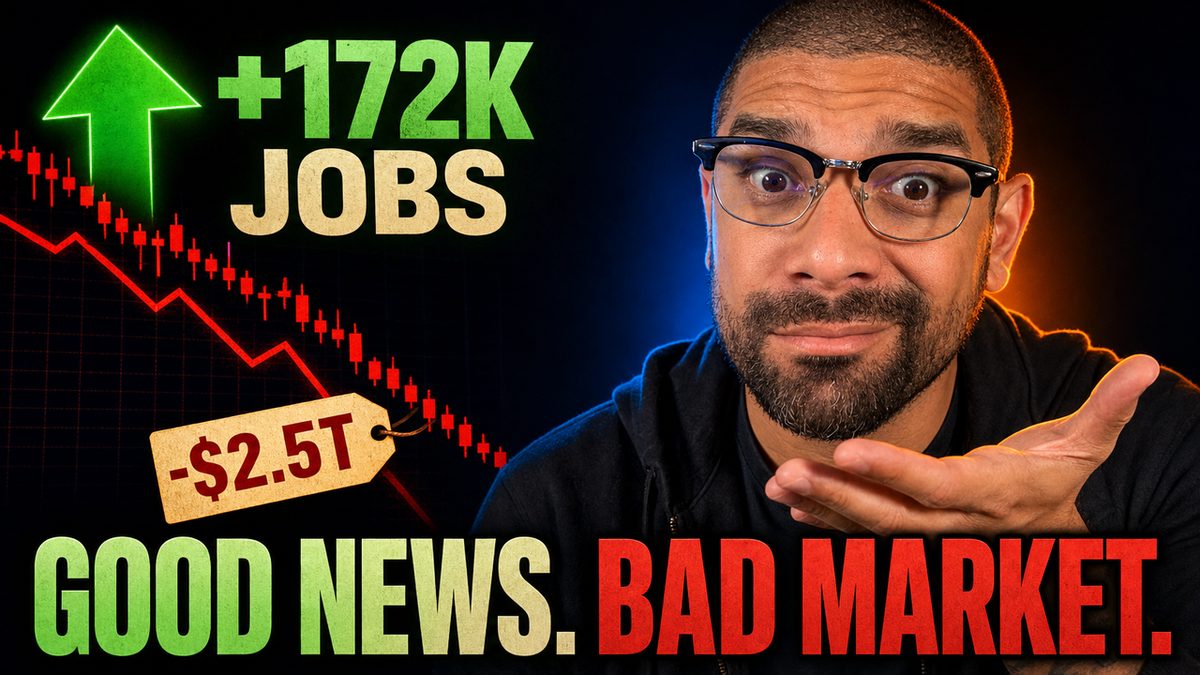
The May jobs report came in at 172,000, more than double the estimate, and stocks, bonds, gold, and bitcoin fell together anyway, roughly $2.5 trillion in a day. The rate cut died, and the SpaceX IPO, priced at a $1.77 trillion valuation, started pulling cash out of everything as funds sell positions to buy in. Your LP's 401k is about to be a forced buyer at the top. This is the playbook for turning that into your raise: the contrast pitch, the transparency edge, the distress buy box, and the compounder you should be building instead of the next deal.
One hundred seventy-two thousand jobs.
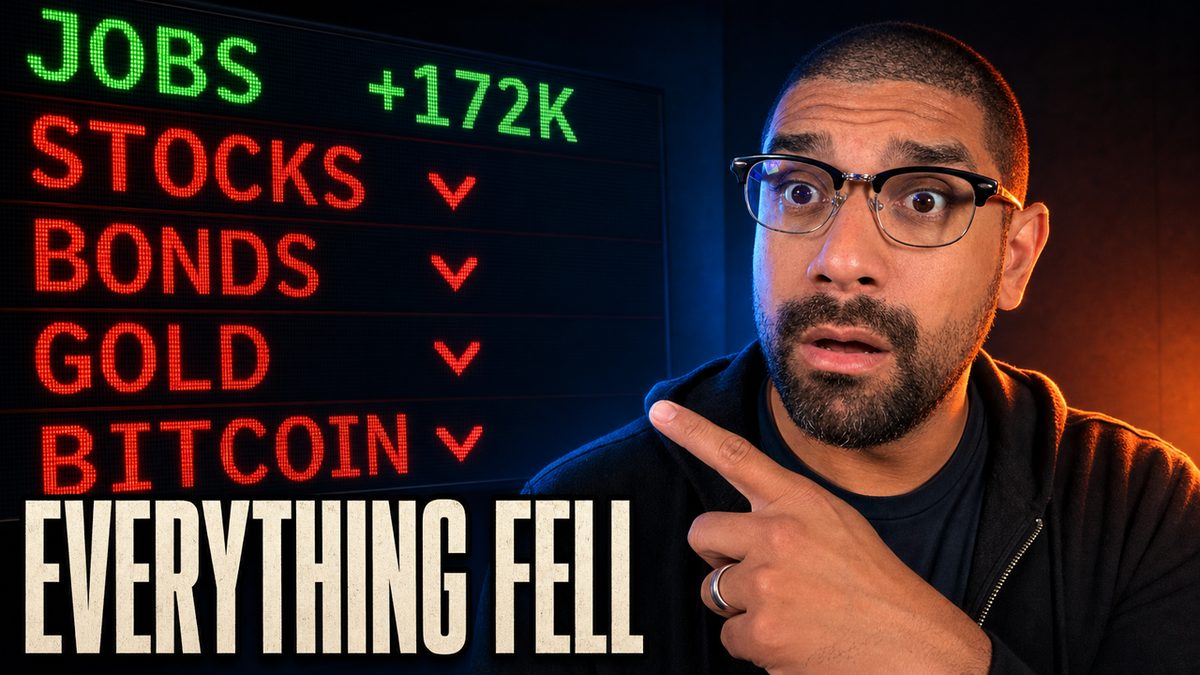
Double what Wall Street expected. And on that news, stocks fell, bonds fell, gold fell, and bitcoin fell. All on the same day. Roughly two and a half trillion dollars of value, gone, on a good number. The reason is not on cable news. The SpaceX IPO, the biggest in human history at $1.77 trillion, is about to vacuum the cash right out of this market, and almost every 401k in America is about to be forced to buy it.
This was a News Hour week where the paper market and the dirt market both repriced at once. Here is the whole episode in writing: why everything fell together, what the liquidity vacuum actually is, the single best fundraising wedge you will get all year, the private credit cracks that are secretly great news for honest operators, a record foreclosure month in Texas, and the Bill Ackman close that ties it all together. Every story comes with one move. Six stories. Six moves. One machine to build.
Why did everything fall the week the SpaceX IPO priced?
Two forces hit the same day. The May jobs report printed 172,000 new jobs against an estimate near 85,000, killing the rate cut: December rate-hike odds jumped to about 68 percent and the 30-year Treasury went back near 5 percent. At the same time, funds and retail investors were selling tech, crypto, and gold to raise cash for the SpaceX IPO and the AI listings behind it. Roughly $2.5 trillion came off in a single session, on good news.
By every normal rule of the last fifteen years, a beat that big sends the market up. Unemployment held at 4.3 percent, wages grew 3.4 percent, and the prior two months got revised up another 93,000 jobs, all per the May jobs report coverage on CNBC. Instead, the Nasdaq had its worst day in over a year. That is what it looks like when the market stops trading the economy and starts trading the calendar.
Now make higher-for-longer concrete, because it is an abstraction until it lands on your debt. Wages grew 3.4 percent while inflation runs near 4, so your tenant is getting poorer in real terms even on a good jobs day. That is collection risk. And a 30-year Treasury back near 5 percent means the agency refinance you penciled at four and a half is gone. On a $10 million loan, that gap is $50,000 to $70,000 a year, per property, in extra debt service. That is the difference between a distribution and a capital call.
Move one is a mindset shift. If your plan still leans on rates coming down to bail you out, let that go. That story died on Friday. We wrote the underwriting reset for this exact regime in the Fed revolt playbook. The honest question for this week: if a great deal landed on your desk in the next ninety days, could you actually move on it? If the answer is no, that is your work.
What is the SpaceX IPO liquidity vacuum?
SpaceX priced the biggest IPO in history at $135 per share, raising about $75 billion at a $1.77 trillion valuation, with trading starting on the Nasdaq June 12. Anthropic filed June 1 at $965 billion after a $65 billion round, and OpenAI is right behind at roughly $2 billion a month in revenue. That is about $3.6 trillion of value hitting the public market at once, versus roughly $45 billion for the entire 2025 US IPO market. To buy in, investors sell what they already own. That selling is the vacuum.
At $1.77 trillion, SpaceX would instantly be the seventh largest company in the United States, bigger than Tesla, and Elon keeps over 82 percent of the voting control. He is selling you the upside and keeping the steering wheel. The pricing details are on CNBC's SpaceX IPO coverage. And these are not three speculative moonshots. Anthropic crossed a $47 billion run-rate and is on track for its first operating profit this quarter, around $559 million. We covered the run-up to that filing last week in the AI capex fund playbook. The number moved up, and then they filed.
This cuts two ways for your raise. The good side: a reopening IPO window at the top thaws everything below it. Your LPs call the freeze the DPI problem, money in and nothing back out for three years. This is the first crack of daylight. The threat side: the same week your LP saw the SpaceX roadshow, every wealth advisor in the country got a new pitch script. Buy the rocket. Get in before it pops. That is direct competition for the dollar that was going into your fund, and your LP read that pitch before they read yours.
Move two: be ready to talk about the IPOs like a normal person. The honest answer is simple. Buying the rocket at $1.77 trillion pays you nothing until you sell it to the next person, and you are the late money. What you offer is the opposite: uncorrelated to chip cycles and rocket launches, it pays people while they hold it, and they get to be early. Nothing rocket-science about it, pun fully intended. Practice saying it until it sounds like you over coffee, not like a rebuttal.
Why is your LP's 401k forced to buy the SpaceX IPO?
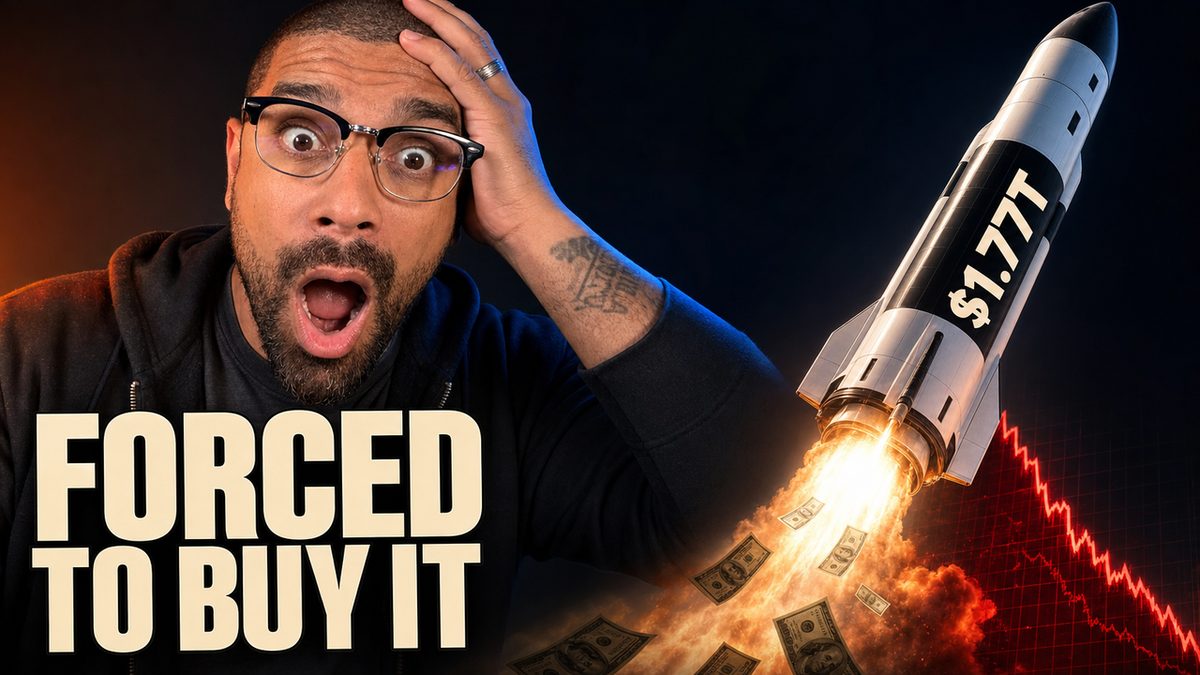
When SpaceX joins the major indexes, every index fund tracking the S&P 500 and Nasdaq 100 must buy it automatically, whatever the manager thinks of a $1.77 trillion valuation. Index providers are changing inclusion rules specifically to make room. Index funds are the backbone of nearly every American 401k, so most retirement accounts become forced buyers at the highest IPO valuation in history. Nobody asked them. The index just does it.
Fortune reported it plainly: SpaceX and Anthropic are about to go public, and your 401k may be forced to buy in. The appetite is real. Cerebras, a much smaller AI chip company, popped 68 percent on its debut this same stretch. And the winners are concentrated: Google alone is reportedly sitting on close to $300 billion in paper gains from its Anthropic stake. The upside flows to a tiny handful of insiders and a forced index. The average person gets the bill, automatically, inside an account they never check.
Why does a room full of fund operators care about 401k mechanics? Because this is the single best fundraising wedge you will get all year, and it is the cleanest version of the contrast you sell:
| SpaceX via the 401k index | An allocation to your fund | |
|---|---|---|
| How it happens | Forced. The index committee decides | Chosen. The LP vets you and decides |
| Entry point | The highest IPO valuation in history, late | Negotiated basis, early |
| Cash flow | None until someone sells the share | Distributions while they hold |
| Accountability | A board answering to shareholders | An operator answering to them |
Move three: share the story, do not pitch it. Forward the article, bring it up on a call. "Did you see this thing about 401ks getting forced into the SpaceX IPO? Kind of crazy. It is the opposite of how I think about putting money to work." You are not selling anything. You are starting a conversation they will genuinely find interesting, and the contrast between forced and chosen sells itself.
Flow AI is the AI employee you can't afford yet.
Fund Flow OS runs your investor outreach, drafts your follow-ups in your voice, and tracks your 506(b) relationships for compliance, all on a multi-model AI stack. That matters more than ever with two of the biggest AI labs heading to the public market: the last thing you want is your firm married to one vendor's roadmap the week it answers to shareholders. Code FIRE gets you 50% off your first three months. Free to start.
Is private credit cracking, and why is that good for your raise?
Jamie Dimon compared this market to 1972, 1986, 2000, and 2007, and warned that private credit marks have not caught up to this year's volatility. The same week, Blackstone's roughly $45 billion BCRED, the largest private credit fund on the planet, got redemption requests near 10 percent of the fund and filled only its 5 percent quarterly cap, per its own filing. Add lawsuits alleging misstated NAVs at several credit funds, and a nervous LP base just started hunting for managers who price honestly. That is your opening.
Take the two halves one at a time. Dimon's bubble comps, covered in Fortune's write-up of his warning, all share one thing: each year came right before the fall. And this is the man sitting on $40 to $50 billion of excess capital telling you he is keeping his powder dry. When the guy with the most dry powder on Wall Street says wait, that is worth ten of the usual permabears.
The BCRED gate is not a scandal. It is the design. A whole generation of evergreen and interval funds got sold to smaller investors as semi-liquid, private-market returns with quarterly liquidity. This week the largest one on earth proved the fine print is real: quarterly liquidity means quarterly liquidity up to a cap, and the cap binds at the exact moment everyone wants out at once, which is the only moment it matters. A lot of LPs are reading that design for the first time.
Here is the contrarian take nobody in your feed will say: this is the best fundraising environment for an honest operator in a decade. Trust does not move in a straight line. It moves in jumps, usually right after a scare, and this week is a scare. The LP who ignored your email in April is reading every word of it in June. That window closes the second the headlines calm down. Move four: lead with the stuff most people save for last. How you actually value what you own. When someone can really get their money back, in plain language. In a market full of gated funds and lawsuits over fake numbers, plain honesty lands like a flex.
What does a record $1.3B Texas foreclosure month mean for your fund?
Texas flagged $1.3 billion of loans for June foreclosure auctions, the most on record: 48 loans, 30 of them in Dallas-Fort Worth, with apartments the biggest category. Roughly $930 billion of commercial real estate debt matures in 2026, and about 60 percent of apartment loans come due in the second half. But distressed sales are still only about 3 percent of all sales versus 20 percent after 2008, because debt funds are absorbing trouble quietly before it hits the courthouse steps. The best deals are private.
For three years the maturity wall was a spreadsheet. This month it became an auction calendar, documented in The Real Deal's Texas foreclosure report. And it is not just garden apartments. The Line Austin, a 428-room luxury hotel, got handed straight back to JPMorgan at the full $172 million owed. The Hyatt Centric down the street sold at auction around 40 percent off the loan balance. Brookfield is winding down its DC office business entirely, and one DC building it was tied to got reappraised from $18.1 million to $550,000. A 97 percent collapse. On one building.
The capital side is arriving at the same time. About $172 billion went into private real estate funds last year, and nearly 90 percent of it went to opportunistic, value-add, and distressed strategies. The deals and the dollars are converging, and your job is to be the bridge. Inside PF Capital, my own real estate firm, we are in these conversations right now, and the discounts in private deal rooms are better than the public headlines, because a bank would rather take 40 percent off in one clean motion than carry a bad loan through two more quarters of audit committees.
Move five, two parts. First, know your buy box cold: metros, asset type, discount threshold, hold period, so you can say yes or no in ten seconds when a broker calls. Second, use this record month as a no-pressure reason to check in with your backers. "That distress we keep talking about is showing up now. I am watching it closely and I will bring you something real when I find it." If you are still sizing whether you can even play, our breakdown of how much it actually costs to launch a fund kills the $20 million myth.
The reframe: build the compounder, not the deal
Let me tell you about a deal, and then what to build instead. Nitya Capital, a well-known Houston syndicator, is facing foreclosure on three North Texas apartment properties. 847 units, about $70 million in debt. Here is the gut punch: roughly one year ago, this same operator closed a $700 million refinance across eighteen properties. That was the "we made it" headline. A year later, 847 units are headed to the auction block anyway. A refinance never fixes a broken deal. It just reschedules the funeral.
Nitya did not have a financing problem. They had a structure problem. Deal, deal, deal, refi, deal, and no machine that survives a bad year. Which is why the most important conversation in finance this week was Bill Ackman on the All-In podcast, laying out the exact antidote. Underwrite the moat, not the turnaround: own durable advantage and let quality compound. Stress-test everything against a five-person AI team with unlimited compute, because if your only edge is speed and a few broker relationships, a machine just ate it. And build the compounder, not the deal: Ackman is openly turning Howard Hughes into a Berkshire 2.0, real estate plus insurance float, stacked into an engine that compounds for decades.
For a real estate fund, the machine is three things working together. One, a repeatable acquisition engine: a defined buy box and a deal flow source that brings the same kind of deal over and over. Two, recurring revenue that exists whether or not you buy a single property this year. Three, an investor base that re-ups, fund one into fund two into fund three, because you built trust, not because you ran a new ad. If you have those three, you have a machine. If every dollar depends on closing the next deal, you have a job that happens to involve real estate. Nitya had a job. Ackman is building a machine. If you are earlier in the journey, the four-step fund launch playbook is where that machine starts.
Move six, the most important one. Sit down this week and write one paragraph answering one question: what is the compounding machine inside my firm? Not the next deal. Not the next raise. The thing that gets more valuable every year whether or not any single deal works out. Then stress-test it against the five-person AI team, and re-underwrite your portfolio to a 6.5 percent world with no rescue refi, the exact world that just took down an operator with a $700 million refinance. If you can write the paragraph, you know what to build. If you cannot, that is not a failure. That is your to-do list for the next twelve months, handed to you for free.
Listen to the full News Hour episode
This article is the written companion to the Funds on Fire News Hour episode on the week the SpaceX IPO broke the market. The audio goes deeper on all six stories and the lightning round: Korea's gigawatt-scale sovereign AI buildout (a real estate story wearing an AI costume), the end of cheap AI as the labs chase profitability, the SpaceX welder who became a millionaire on equity, Franklin Templeton wiring a tokenized fund to stablecoins, the SEC's qualified-client threshold rising June 29 (call your fund attorney Monday), bitcoin's 2026 low, and why 6.5 percent mortgage rates are the new normal to underwrite against.
Six stories. Six moves. One machine to build.
Every story ends with one thing you do this week. No hype, just what it means for how you raise and deploy capital.
Frequently asked questions
Why did stocks, bonds, gold, and bitcoin all fall on a strong jobs report?
How big is the SpaceX IPO?
Will my 401k be forced to buy SpaceX stock?
Why did Blackstone's BCRED gate redemptions?
What does "build the compounder, not the deal" mean for fund managers?
To great success and greater impact.
Keep reading
 News Hour
NVIDIA's $81.6B Quarter and the AI Capex Fund Playbook
$81.6B in one quarter. Anthropic past OpenAI at $900B. Banks dumping CRE debt at 85% off. Here's what your fund does this week.
 Fund Building
How Much Money Do You Need to Launch a Real Estate Fund?
The $20 million minimum is a myth. Here's the real number, line item by line item, and the structure that gets you there.